|
ACTIVITIES!! |
Saturday and Sunday July 25th &
26th, 2009
9:00 am - 4:00 pm
Cue Classes
Beginning
Cued Speech and Cued Speech Skills
Class
Registration
Form
Location:
Deerwood Elementary School
Apple Valley, MN |
|
|
Minnesota Hands & Voices
Family
Picnic
at
Como Park
Midway Pavilion South
Thursday August 6,
2009
5:00pm-8:30pm
RSVP by Monday
August 3rd
Cued Language
Transliterator and ASL Interpreter
at this event
More Information |
|
|
Cue at the Beach
Friday July 10, 2009,
3pm to
7 pm
Bryant Lake Regional
Park
6800 Rowland Road,
Eden Prairie, MN
Bring Your Own
Picnic and Come Join Us for a fun
time of swimming at the beach!
Free! |
|
What is Cued Speech?
"Who Uses
Cued Speech"
is a fourteen minute video from the
National
Cued Speech Association.
Hearing and Deaf parents discuss how and why
they chose to communicate using Cued
American English with their child(ren).
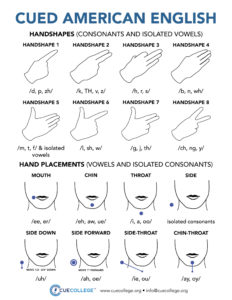
Cued Speech is a visual communication system
which, in English, uses eight handshapes
in four different positions around the face
in combination with the natural mouth
movements of speech to make all of the
sounds (phonemes) of spoken language look
different. Phonemes are the smallest
unit of English, or the building blocks,
that distinguish one word from another.
One cue, therefore, is a combination of a handshape, position, and mouth movement.
This combination creates clear and
unambiguous spoken language access for deaf
and hard-of-hearing individuals. Using
the system of Cued
Speech to convey a traditionally spoken
language provides access to the following
additional critical components of that
language:
phonemic awareness, syntax (sentence word
order), semantics (vocabulary, word
meanings), morphology (word endings) and
idioms.
Cued
Speech was developed by Dr. Orin Cornett in 1966 while working at Gallaudet
University. He developed Cued Speech with
the express purpose of providing a way for
children who are deaf or hard of hearing to
become good readers. The
visual representation of a spoken language
using Cued Speech produces phonemic
awareness.
Phonemic awareness
does not have to be acoustic, it can be
visual, via Cued Speech. Phonemic
awareness is a prerequisite skill to being a
successful reader and is the best predictor of how well
children will learn to read during their
first two years in school.
Cued Speech allows deaf and hard-of-hearing
individuals to "internalize" the language
they see.
Cued Speech has been adapted to over 55
different languages, which allows parents to
communicate with their
children in their native, traditionally spoken language.
Parents are then able to provide their child
with natural and complete language exposure
and access. Since Cued Speech uses
the natural mouth movements of speech,
speech reading skills are also developed.
Speech clinicians use Cued Speech to show
what sound they would like produced and also
what sound was actually produced. Research
indicates that using Cued Speech to cue a
traditionally spoken language is beneficial
for the development of language, reading,
speech reading and auditory skills.
To see
video clips of Cued Speech, a
Cued Speech
chart or
simply to explore other resources, please
visit our
links
page. |